

The European Commission adopted the EU Ports Strategy and the Industrial Maritime Strategy on 4 March 2026, setting out a comprehensive framework to strengthen the competitiveness, resilience, security and sustainability of Europe’s ports. A key element of the strategy is the development of hydrogen infrastructure, recognising ports as critical gateways for the future hydrogen economy.
The Clean Hydrogen Partnership is already playing an important role in supporting this transition. Through a broad portfolio of EU-funded projects, the Partnership has been advancing hydrogen technologies across the maritime value chain, from port operations and infrastructure to vessels and bunkering solutions.
Ports are natural entry points for hydrogen and hydrogen carriers entering Europe and are also central to the development of cross-border hydrogen valleys. Accelerating investment in hydrogen-related infrastructure in port areas will be essential to supply decarbonised hydrogen to Europe’s industries and transport networks.
The Clean Hydrogen Partnership remains committed to supporting the European Commission in advancing the decarbonisation of Europe’s ports and maritime sector. In this context, the Partnership will commission a study in 2026 to support the Commission’s activities within the Hydrogen Global Ports Coalition under the Clean Energy Ministerial.
Projects Enabling Hydrogen in Ports and Maritime Transport
Projects supported by the Clean Hydrogen Partnership are helping lay the foundations for the use of hydrogen in ports and maritime transport.
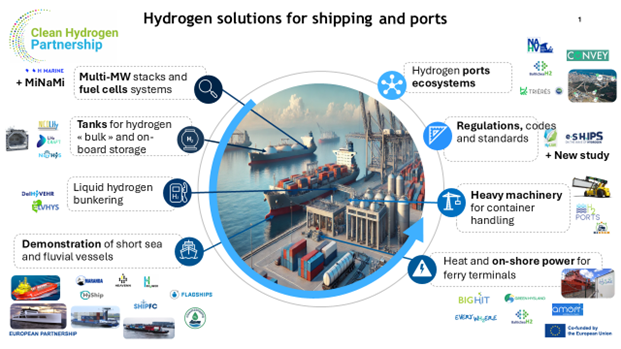
Several Hydrogen Valleys located in port regions, including Convey, BalticSeaH2, Trieres and NAHV, are developing hydrogen port ecosystems across Denmark, to Baltic region, Italy, Croatia and Greece. These initiatives demonstrate how hydrogen production, distribution and end use can be integrated within port environments.
Other projects are targeting the decarbonisation of port operations. For example, H2Ports in the Port of Valencia (Spain) is demonstrating hydrogen-powered heavy machinery for container handling. Meanwhile, BIG HIT, EVERYWH2ERE and Green Hysland in Mallorca are exploring hydrogen solutions for heat supply and on-shore power at ferry terminals.
The Clean Hydrogen Partnership is also supporting hydrogen-powered vessels. Projects such as Flagships, RH2IWER, Hyship and Maranda are demonstrating hydrogen propulsion technologies for short-sea and inland maritime transport.
At the same time, projects including DelHyVEHR and Elvhys are developing technologies for liquid hydrogen bunkering. In parallel, NicolHY, LH2Craft and NAVHYS are advancing hydrogen storage tanks for both bulk transport and onboard use. Supporting technologies are also being advanced through H2Marine and MiNaMi which are developing multi-megawatt PEM fuel cell systems for maritime applications.
Finally, projects such as E-SHyIPS and HyLAW are contributing to the development of regulations, codes and standards, helping to create the regulatory framework needed for safe hydrogen deployment in maritime environments.
Supporting Europe’s Maritime Energy Transition
Together, these projects demonstrate how the Clean Hydrogen Partnership is contributing to the objectives of the EU Ports Strategy and supporting the decarbonisation of Europe’s maritime sector.
By advancing technologies, infrastructure and regulatory frameworks, the Clean Hydrogen Partnership continues to help pave the way for hydrogen-powered ports and shipping across Europe.
For more information, discover our project dashboard.
- Publication date
- 16 March 2026
- Author
- Clean Hydrogen Joint Undertaking