
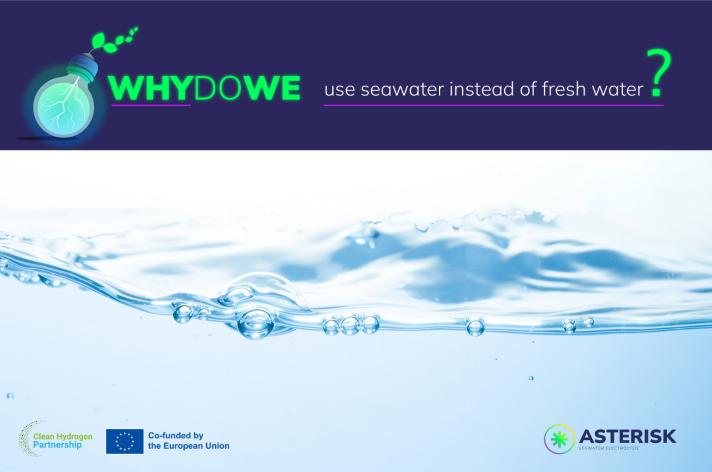
Most green hydrogen technologies depend on fresh water - a scarce resource that should be prioritised for drinking, agriculture, and livestock. Building on earlier research, the ASTERISK project aims to overcome this limitation by developing an electrolyser capable of producing green hydrogen directly from seawater.
The project will analyse seawater samples from three Mediterranean locations and tackle key challenges such as corrosion from salinity, chlorine management, and the presence of microorganisms and microplastics. To address these, ASTERISK will develop Anion Exchange Membrane (AEM) electrolyser components designed to operate reliably in saline conditions, alongside a low-energy, minimal seawater pre-treatment step that removes biological and suspended solids without stripping natural ions.
While technically complex, direct seawater electrolysis offers a major opportunity: enabling local, sustainable energy production in remote and island regions, especially when combined with renewable sources like wave or tidal power.
By the end of the project, ASTERISK will deliver a proof-of-concept electrolyser operating in harsh marine environments, marking a significant step toward more sustainable and accessible clean hydrogen technologies.
This effort complements broader initiatives supported by the Clean Hydrogen Partnership, which is also funding related projects such as HySEas, Sea4Volt, and SWEETHY.
🔗 Learn more about ASTERISK in the dedicated factsheet and explore the latest project videos.