


Summary
As the European Commission prepares to renew its Hydrogen Strategy, the Clean Hydrogen JU sets out three priorities to turn Europe’s R&I strengths into competitive technologies and projects ready for deployment at scale. Read more and respond to the call for evidence by 23 November.
Towards a strategic framework to turn Europe’s hydrogen innovation into industrial impact
Clean hydrogen and its derivatives will be indispensable in Europe’s energy system and achieving climate-neutrality, to support industrial-competitiveness and continue to resilience objectives, industrial competitiveness and autonomously. Without hydrogen it will be impossible to decarbonize hard-to-abate sectors. Hydrogen R&I must therefore encompass also derivatives such as synthetic fuels (e.g. e-methanol, or sustainable aviation fuels) and chemical feedstocks such as ammonia to replace fossil-based products in applications that cannot be fully electrified.
The key element that should be included in the revised hydrogen strategy is long-term predictable investment in R&I and deployment. This will confirm Europe’s long-term commitment and thereby secure existing and planned investments and finally increase the competitiveness of European technologies and closes the cost gap with fossil-based alternatives.
1. Unlocking hydrogen’s potential through complete value chains
Realising the full potential of hydrogen and its derivatives for decarbonisation, EU competitiveness and resilience, requires moving beyond individual technology development to establishing complete clean-molecule value chains. These value chains will link renewable and low-carbon energy, hydrogen production, derivative synthesis, transport, storage, distribution and end users.
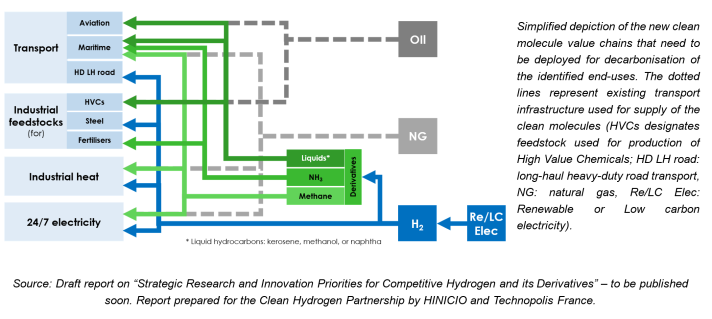
Priority value chains include applications where clean hydrogen/molecules can simply substitute fossil fuels/molecules and direct hydrogen use, new derivatives or fundamentally different production routes. Prioritised value chains should be in hydrogen-based steel, clean fuel production/bunkering for maritime, synthetic fuels for aviation, hydrogen supply for high-capacity refuelling infrastructure and vehicle fleets along freight corridors, integrated supply for industrial clusters and the chemical industry and long direction molecular storage and conversion for dispatchable electricity.
Deploying these value chains will require stable enabling conditions and sustained coordination between public-, industrial- and research organisations.
2. Sustaining Europe’s competitiveness through a two-track R&I approach to near-term deployment and longer-term innovation
Europe enters the energy transition with significant strengths in research and innovation, engineering, safety, standards, industrial process expertise and midstream infrastructure. However, these strengths have not yet translated consistently into deployment at scale. A gap remains between successful R&I and demonstration, on the one hand, and manufacturable products, bankable projects, final investment decisions and repeatable commercial deployment, on the other. Deploying the necessary value chains require R&I actions to (track 1) support the deployment of mature solutions and simultaneously (track 2) to the development of next-generation technologies:
- Track 1 accelerates the deployment of complete clean-molecule value chains using high-TRL technologies. It supports deployment by 2030 through Hydrogen Valleys and other coordinated value-chain projects, with the objective of achieving measurable decarbonisation and industrial impact at scale by 2035. R&I should address the remaining barriers to commercial deployment: durability, reliability, qualification, manufacturability, technical bankability, interoperability, safety, maintainability, and standardisation. It should also support the coordinated deployment of production, infrastructure and end-use investments, establishing the industrial base and operating systems into which next-generation technologies can progressively be integrated
- Track 2 develops the next generation of technologies and integrated systems. It focuses primarily on mid- and low-TRL solutions that overcome the intrinsic limitations of incumbent technologies or enable deeper integration across energy and industrial systems. This track support technologies expected to reach market maturity 2040 and 2050.
3. Move from R&I to deployment at scale
R&I must develop hydrogen technologies together with the industrial capabilities needed to manufacture and deploy them at competitive cost. Manufacturing-oriented R&I should develop the equipment, tooling, production processes and assembly capabilities needed to manufacture and qualify larger-capacity components, stacks, modules and complete systems efficiently and reliably.
In addition to the above R&I framework, it is necessary to continue and reinforce strategic positioning Hydrogen Valleys, as they provide a framework for developing and deploying such value chains as integrated systems. Projects are often brought forward for CAPEX/OPEX support before they are investment-ready, contributing to withdrawals and terminations even when funding is available. Assessing maturity, commercial viability and implementation risks is therefore essential. Targeted support for development expenditure (DEVEX) is needed throughout the pre-FID phase, when expenditure is relatively limited compared with construction, but uncertainty and development risks remain high. Combined with CAPEX and OPEX support addressing the commercial viability gap, DEVEX support would provide continuity across the project lifecycle and accelerate deployment.
What does it take to implement the R&I framework?
Deploying these value chains and accompanying R&I actions and deployment, requires stable enabling conditions and sustained coordination between relevant parties. An institutionalised public–private partnership (PPP), implemented through a Joint Undertaking, allows a shared public – private governance, long-term continuity and dedicated mandated resources needed to coordinate these interdependent actors and investments. Fragmented support would weaken investment certainty and the coordinated scale-up of European companies, increasing the risk that competitors capture the manufacturing capacity, markets and value arising from decades of European innovation. Europe must therefore preserve a strong institutionalised public–private partnership and predictable support from research to deployment, translating technological leadership into lasting competitiveness and resilience.
Furthermore, the Clean Hydrogen Joint Undertaking is uniquely positioned to coordinate EU, national and regional funding options and instruments, including the funding of hydrogen in the post-2027 MFF architecture covering both FP10/Horizon Europe (for R&I support activities) as well as the European Competitiveness fund to support project development (including DEVEX) related activities.
Finally, building on the hydrogen ecosystem developed by the Clean Hydrogen JU since 2008, an enlarged Partnership is uniquely positioned to prioritise and align R&I efforts with industry needs, thereby enabling the scale-up of manufacturing capacity and the deployment of technologies for hydrogen and its derivatives.
Have your say
The call for evidence on the renewed European Hydrogen Strategy is open until 23 November via the European Commission’s Have Your Say portal. Stakeholders are invited to share their views on the priorities the strategy should address and the role of research and innovation in connecting technology development with manufacturing and deployment. An accompanying paper sets out the Clean Hydrogen Partnership’s recommendations in more detail.
- Publication date
- 17 November 2026
- Author
- Clean Hydrogen Joint Undertaking