
The PEACE project, funded by the Clean Hydrogen Partnership under the Horizon Europe programme, has reached an important step on the route to a full-scale demonstration of highly efficient pressurised alkaline electrolysis (AEL): construction and assembly of a three-cell AEL short stack.
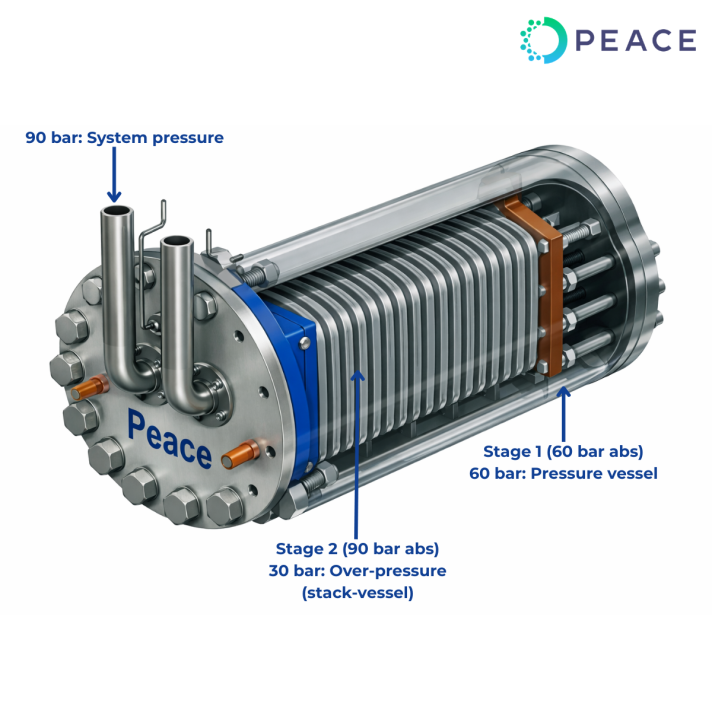
Developed and assembled by Materials Mates Italia (MMI), the short stack represents the scale-up of solutions validated in earlier PEACE project activities. Its design ensures full compatibility with the Brandenburg University of Technology Cottbus–Senftenberg (BTU) test infrastructure, including installation inside a pressurized vessel and operation under dual-stage pressurization conditions.
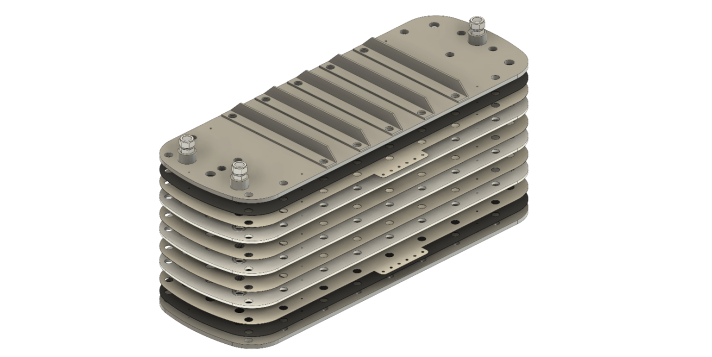
The PEACE short stack comprises several key elements where we tested our innovative solutions:
- Plastic parts: separator body and gasket press precisely machined with a low cost, agile process that allows us fast modifications
- Metallic parts and endplates: bipolar plates and end plates aiming at a minimum weight with outstanding pressure resistance
- Sealings: standard O-ring technology with high level performances
- Diaphragm, Elastic element and electrodes: electrodes are kept in place by customized knitted nickel mesh with calibrated force.
Particular emphasis was placed on low-cost, scalable manufacturing approaches, avoiding critical mechanical processes and relying on materials with high availability—key requirements for future industrial deployment.
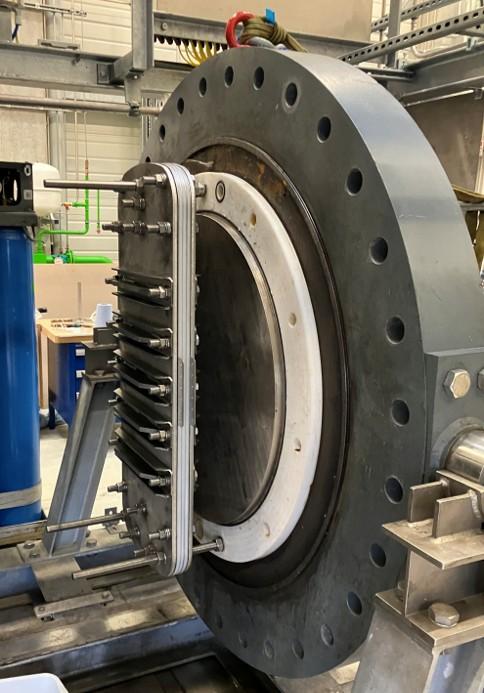
Stack assembly reflects close collaboration between industry and academia within the PEACE project. Industrial expertise from MMI builds on prior electrochemical performance test evaluation works carried out at German Aerospace Center (DLR) and Eindhoven University of Technology (TU/e), demonstrate how the combination of industrial expertise and scientific excellence accelerates innovation in green hydrogen technology.
The next PEACE project objective is the development of a cost-competitive, pressurized alkaline electrolyser for large-scale green hydrogen production (>50kW) previewed to be operational at BTU premises in 2026.
The PEACE concept of hydrogen production is based on the development of a pressurized, high-efficiency stack. The two-stage pressurization approach is implemented: stack-level pressure combined with hydraulic pressure within the vessel in which the stack is mounted. This concept will be demonstrated on an AEL system exceeding 50 kW, capable of operating at pressures above 50 bar.
Hydrogen produced through PEACE will already be compressed, allowing direct feed into gas networks or industrial chemical processes. This innovation aims to reduce both capital (CAPEX) and operational (OPEX) expenditures of electrolysis systems used in the chemical sector.